
News Categories
2026-11-23
Custom Industrial Portable Energy Storage: How BST Power Develops a 3.68kWh / 7.2kW Off-Grid ESS
From product concept to customized engineering: an industrial portable energy storage ODM project designed for diesel generator replacement and reliable off-grid power.
Introduction
As European construction sites and industrial applications increasingly explore alternatives to conventional diesel generators, portable energy storage systems are becoming an important option for temporary and off-grid power supply.
However, developing an industrial portable energy storage system is not simply a matter of combining a battery with an inverter.
Different applications require specific power outputs, battery configurations, electrical interfaces, control logic, communication protocols, safety features, and product structures.
For energy storage brands and equipment manufacturers, finding an experienced portable ESS ODM manufacturer that can translate a clearly defined product concept into a functional, application-specific system is essential.
At BST Power, we provide customized energy storage development covering battery systems, inverter integration, BMS engineering, embedded software adaptation, and complete system integration.
One recent European project demonstrates this capability: the development of a 3.68kWh / 7.2kW industrial portable off-grid energy storage system, designed primarily as an alternative to conventional industrial diesel generators.
This project illustrates how BST Power approaches complex ODM requirements, from technical discussions and solution definition to engineering development and sample preparation.
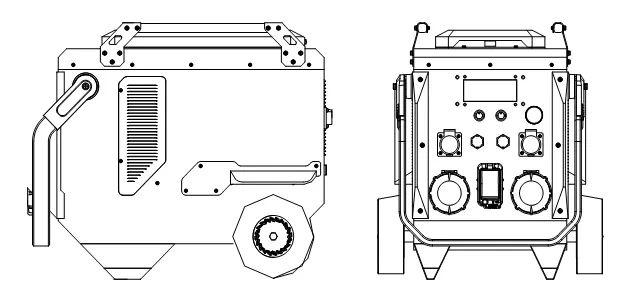
1. Understanding the Application: Portable ESS for Diesel Generator Replacement
The project was initiated by a European customer with extensive experience in portable power equipment.
The customer had already established a clear understanding of the target market, product positioning, and application requirements.
The main objective was to develop a portable off-grid energy storage system suitable for multiple applications, particularly:
-
Temporary power supply for European construction sites.
-
Replacement of conventional industrial diesel generators.
-
Portable power for equipment and tools in off-grid environments.
-
Emergency backup power for residential applications.
Compared with conventional fuel-powered generators, battery-based portable energy storage offers an alternative power supply without on-site fuel combustion during operation.
It also provides an opportunity to develop quieter, more flexible power equipment.
For this project, the product needed to integrate battery storage, inverter conversion, battery management, electrical protection, and a user-oriented control interface into one portable system.
Rather than starting from an entirely new product concept, BST Power evaluated its existing technical platform and developed a customized solution around the customer's application requirements.
2. Product Engineering: Integrating Battery, Inverter and Control Systems
The PT-SL-AC3.7/7.2 is a customized portable energy storage solution developed around a high-power AC output requirement.
Its system architecture integrates a LiFePO4 battery system, Battery Management System (BMS), and inverter module into a portable all-in-one design.
Key technical specifications
| Parameter | Specification |
|---|---|
| Product model | PT-SL-AC3.7/7.2 |
| Battery chemistry | LiFePO4 |
| Rated battery voltage | 51.2V |
| Rated battery capacity | 72Ah |
| Rated battery energy | 3.68kWh |
| Rated AC output power | 7,200W |
| Rated AC output voltage | 220/230/240Vac |
| Output frequency | 50Hz / 60Hz |
| AC output waveform | Pure sine wave |
| Maximum AC charging power | 3,000W |
| Maximum overload capacity | 14,400VA for 5 seconds |
| Protection rating | IP54 |
| Product weight | Approximately 75kg |
| Product dimensions | 712 × 580 × 445mm |
Specifications are based on the project product specification. Final configurations are subject to the approved product version.
2.1 Customized inverter integration
The inverter is one of the most important components in an industrial portable ESS, directly influencing output performance, load compatibility, and overall system operation.
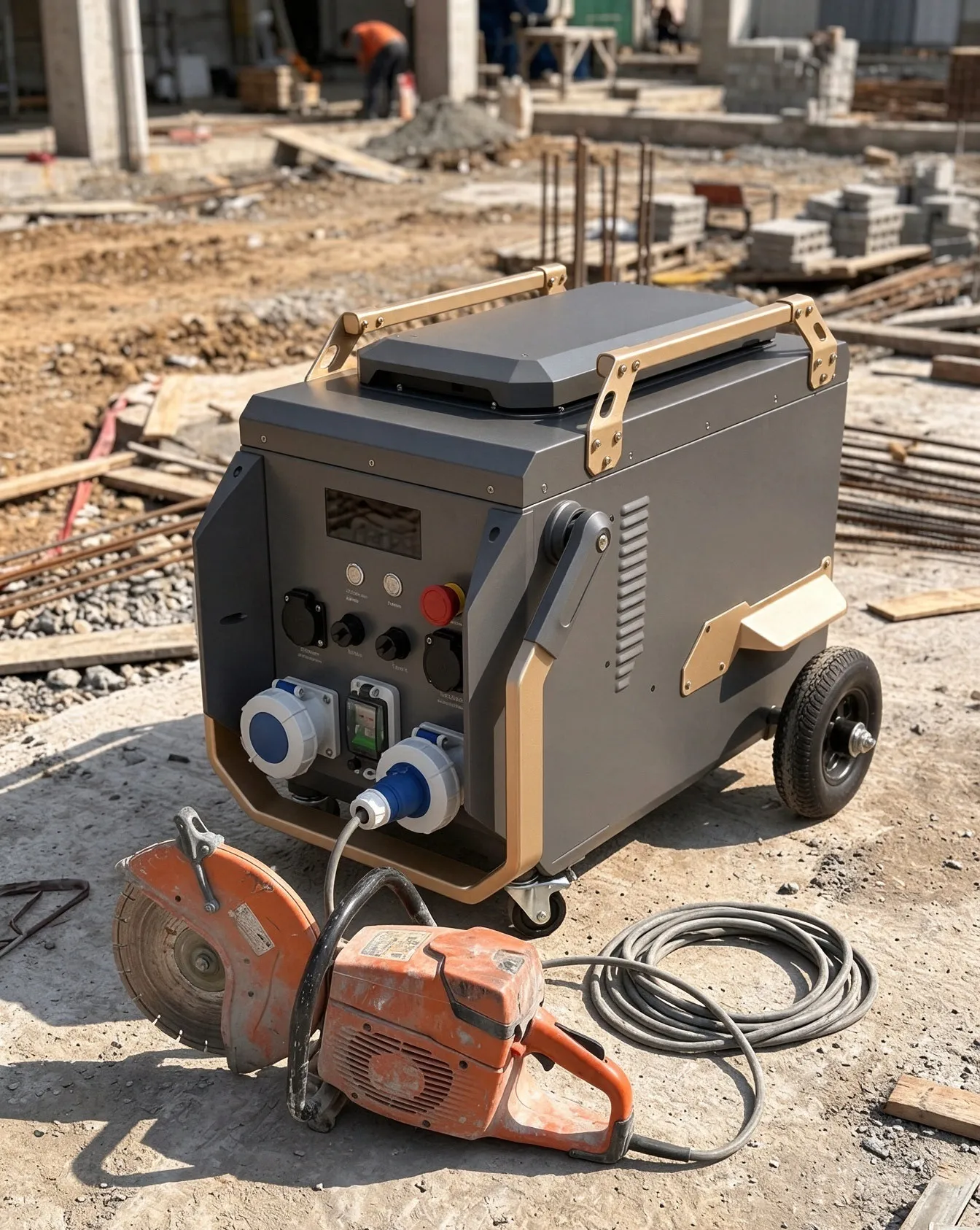
For this project, BST Power integrated the inverter module into the battery system to achieve a rated AC output of 7.2kW.
The system supports:
-
220V / 230V / 240V AC output.
-
Automatic 50Hz / 60Hz frequency detection.
-
Pure sine wave output.
-
Two 230Vac / 32A output interfaces.
-
Two 230Vac / 16A output interfaces.
-
Combined maximum AC output of 7,200W.
This multi-interface configuration allows the portable ESS to supply different electrical loads through a single integrated power system.
2.2 BMS development and battery system integration
Battery safety and system coordination are critical considerations in high-power portable energy storage equipment.
The project uses LiFePO4 battery technology, integrated with a high-performance BMS to support battery monitoring, charge and discharge management, and system protection.
The battery system also incorporates customized expansion logic, allowing one additional battery expansion pack to be connected through the DC side.
The expansion design requires coordinated control between the main unit and the additional battery pack, including charge/discharge switching logic and system startup procedures.
This is an important aspect of ODM development: battery expansion is not simply a matter of adding more battery capacity.
The electrical architecture, BMS communication, and control logic must work together as an integrated system.
2.3 Embedded software and communication protocol customization
Different customers may use different control strategies, monitoring requirements, and communication protocols, even when their products share a similar hardware architecture.
For this project, the underlying inverter software architecture was based on an existing platform, while communication protocol adaptation was supported according to the customer's requirements.
The project did not require a cloud monitoring platform.
This approach allows BST Power to focus development resources on the functions that directly affect the customer's product application, rather than adding unnecessary software features.
For portable ESS brands and equipment manufacturers, this type of customized software and protocol integration can be particularly valuable when developing products for an existing equipment ecosystem.
3. Customized Product Structure and User Interface
Industrial portable energy storage equipment must balance electrical performance with portability, operating convenience, and protection.
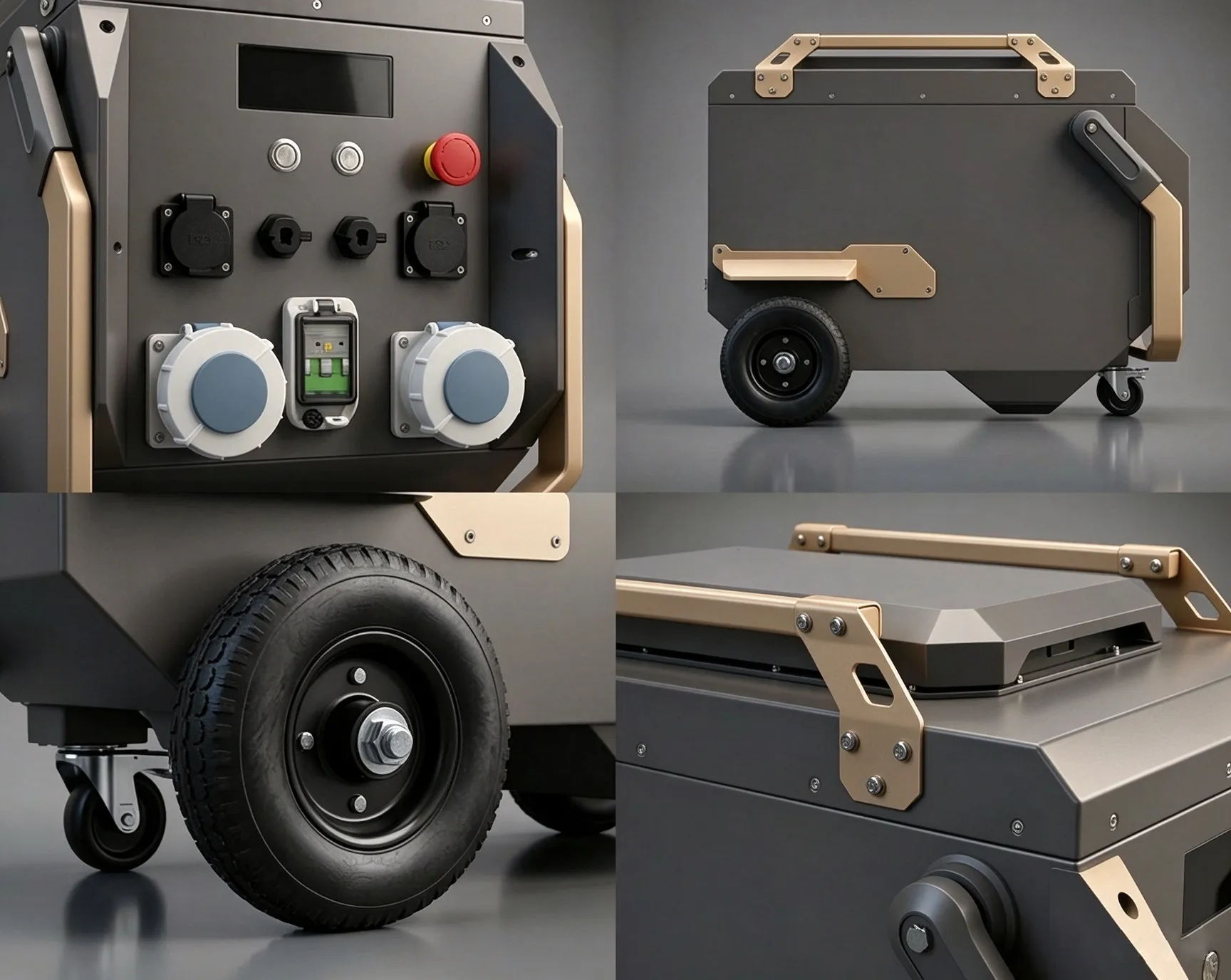
For the European project, BST Power developed an integrated portable enclosure with a wheeled structure and dedicated connection interfaces.
The product includes:
-
An integrated LCD display.
-
Power control button.
-
Emergency stop switch.
-
AC output control switch.
-
Residual current device (RCD).
-
Dedicated battery expansion interface.
-
AC charging port.
-
Type-C output interface supporting up to 60W.
The LCD interface provides important operating information, including battery state of charge (SOC), charging and discharging power, remaining charging/discharging time, and fault alarms.
Safety-oriented functions are also incorporated into the system design. The emergency stop switch can immediately interrupt equipment output when required, while the RCD provides additional electrical protection.
The AC output control system manages the available output interfaces, with a combined rated output capacity of up to 7.2kW.
These details demonstrate that industrial portable ESS customization involves more than selecting battery capacity and inverter power.
Mechanical design, electrical interfaces, protection functions, and user operation must be considered together.
4. Engineering for European Market Requirements
Developing an energy storage product for the European market requires attention to applicable safety, electromagnetic compatibility, transportation, and regulatory requirements.
For this project, the customer identified the following standards and compliance areas as part of its market-entry requirements:
Electrical safety
-
IEC 62040
-
IEC 63056
Electromagnetic compatibility
-
IEC 61000 series
Battery transportation
-
UN38.3 transportation requirements.
EU Battery Regulation and Digital Battery Passport
For private-label products, the customer's role as the brand owner and responsible economic operator must be considered when determining battery passport responsibilities.
BST Power can support the process by providing relevant battery technical documentation, product data, and cooperation during required testing and verification.
The applicable standards, certification scope, testing requirements, and regulatory responsibilities need to be confirmed according to the final product configuration and target market.
BST Power works with customers during the product development process to evaluate these requirements and provide technical support for the corresponding compliance preparation.
5. BST Power's ODM Development Process
A successful ODM project begins with a clear understanding of the customer's product definition.
In this European project, the customer already had professional knowledge of the portable power market and a well-defined product direction.
The development process therefore focused on translating the customer's requirements into an achievable engineering solution.
Step 1: Customer requirement analysis
The customer visited BST Power to discuss the intended application, product positioning, performance expectations, and technical requirements.
Our sales, R&D, and technical support teams participated in the discussions.
Key evaluation areas included battery capacity, inverter power, system architecture, communication protocols, product interfaces, and target-market requirements.
Step 2: Technical solution development
Based on the customer's requirements and BST Power's existing product capabilities, the engineering team evaluated the available technical platform and prepared a customized product proposal.
The initial solution discussion and proposal preparation were targeted for completion within approximately one week.
This stage helps both parties establish a clear technical direction before entering detailed engineering development.
Step 3: Solution review and confirmation
The proposed architecture, technical parameters, functional requirements, and product configuration were reviewed with the customer.
Following customer confirmation, the project could proceed to sample order placement and subsequent engineering development.
Step 4: Engineering development and validation
Because this was a highly specialized product with limited direct reuse potential, the project required a dedicated development cycle.
The estimated development period was approximately nine months.
This included customized engineering work across the product architecture, hardware integration, software adaptation, system functions, and product validation.
The development schedule for each ODM project depends on the complexity of the requested functions, the extent of hardware changes, testing requirements, and certification scope.
6. Why Choose BST Power for Portable Energy Storage ODM?
For energy storage brands and industrial equipment manufacturers, choosing an ODM partner is about more than manufacturing capacity.
The ability to understand product requirements, coordinate different engineering disciplines, and deliver an integrated system is equally important.
BST Power provides energy storage OEM/ODM services covering:
Integrated battery and inverter engineering
Development and integration of battery systems, BMS, and inverter modules for application-specific energy storage products.
Hardware customization
Support for customized electrical configurations, interfaces, product structures, and system integration.
BMS and EMS development
Adaptation of battery management functions, system control strategies, and communication protocols according to project requirements.
Embedded software customization
Support for software function adaptation and communication protocol development based on existing platforms and project requirements.
Application-oriented product development
Solutions for residential energy storage, portable off-grid power, industrial applications, and customized battery systems.
Technical support for market compliance
Cooperation in product testing, technical documentation, and preparation for applicable market-entry requirements.
From a customized battery pack to a complete portable energy storage system, BST Power works with customers to turn application requirements into practical engineering solutions.
Conclusion: Turning Product Requirements into Customized Energy Storage Solutions
The European portable ESS project demonstrates how BST Power approaches complex industrial energy storage ODM development.
By combining existing product platforms with customized inverter integration, BMS engineering, software adaptation, mechanical design, and system-level development,
BST Power helped translate a clearly defined customer requirement into a dedicated portable off-grid energy storage solution.
For companies developing industrial portable power equipment, diesel generator replacement systems, or specialized off-grid energy storage products, an experienced ODM partner
can make a significant difference in the transition from product concept to engineering implementation.
Looking for a portable energy storage OEM/ODM manufacturer?
BST Power supports customized battery systems, inverter integration, BMS development, communication protocol adaptation, and complete energy storage system engineering.
Contact our team to discuss your product requirements and explore a suitable ODM development solution.
BST Power – Your Energy Storage OEM/ODM Partner.
From product concept to customized engineering: an industrial portable energy storage ODM project designed for diesel generator replacement and reliable off-grid power.
Introduction
As European construction sites and industrial applications increasingly explore alternatives to conventional diesel generators, portable energy storage systems are becoming an important option for temporary and off-grid power supply.
However, developing an industrial portable energy storage system is not simply a matter of combining a battery with an inverter.
Different applications require specific power outputs, battery configurations, electrical interfaces, control logic, communication protocols, safety features, and product structures.
For energy storage brands and equipment manufacturers, finding an experienced portable ESS ODM manufacturer that can translate a clearly defined product concept into a functional, application-specific system is essential.
At BST Power, we provide customized energy storage development covering battery systems, inverter integration, BMS engineering, embedded software adaptation, and complete system integration.
One recent European project demonstrates this capability: the development of a 3.68kWh / 7.2kW industrial portable off-grid energy storage system, designed primarily as an alternative to conventional industrial diesel generators.
This project illustrates how BST Power approaches complex ODM requirements, from technical discussions and solution definition to engineering development and sample preparation.
1. Understanding the Application: Portable ESS for Diesel Generator Replacement
The project was initiated by a European customer with extensive experience in portable power equipment.
The customer had already established a clear understanding of the target market, product positioning, and application requirements.
The main objective was to develop a portable off-grid energy storage system suitable for multiple applications, particularly:
-
Temporary power supply for European construction sites.
-
Replacement of conventional industrial diesel generators.
-
Portable power for equipment and tools in off-grid environments.
-
Emergency backup power for residential applications.
Compared with conventional fuel-powered generators, battery-based portable energy storage offers an alternative power supply without on-site fuel combustion during operation.
It also provides an opportunity to develop quieter, more flexible power equipment.
For this project, the product needed to integrate battery storage, inverter conversion, battery management, electrical protection, and a user-oriented control interface into one portable system.
Rather than starting from an entirely new product concept, BST Power evaluated its existing technical platform and developed a customized solution around the customer's application requirements.
2. Product Engineering: Integrating Battery, Inverter and Control Systems
The PT-SL-AC3.7/7.2 is a customized portable energy storage solution developed around a high-power AC output requirement.
Its system architecture integrates a LiFePO4 battery system, Battery Management System (BMS), and inverter module into a portable all-in-one design.
Key technical specifications
| Parameter | Specification |
|---|---|
| Product model | PT-SL-AC3.7/7.2 |
| Battery chemistry | LiFePO4 |
| Rated battery voltage | 51.2V |
| Rated battery capacity | 72Ah |
| Rated battery energy | 3.68kWh |
| Rated AC output power | 7,200W |
| Rated AC output voltage | 220/230/240Vac |
| Output frequency | 50Hz / 60Hz |
| AC output waveform | Pure sine wave |
| Maximum AC charging power | 3,000W |
| Maximum overload capacity | 14,400VA for 5 seconds |
| Protection rating | IP54 |
| Product weight | Approximately 75kg |
| Product dimensions | 712 × 580 × 445mm |
Specifications are based on the project product specification. Final configurations are subject to the approved product version.
2.1 Customized inverter integration
The inverter is one of the most important components in an industrial portable ESS, directly influencing output performance, load compatibility, and overall system operation.
For this project, BST Power integrated the inverter module into the battery system to achieve a rated AC output of 7.2kW.
The system supports:
-
220V / 230V / 240V AC output.
-
Automatic 50Hz / 60Hz frequency detection.
-
Pure sine wave output.
-
Two 230Vac / 32A output interfaces.
-
Two 230Vac / 16A output interfaces.
-
Combined maximum AC output of 7,200W.
This multi-interface configuration allows the portable ESS to supply different electrical loads through a single integrated power system.
2.2 BMS development and battery system integration
Battery safety and system coordination are critical considerations in high-power portable energy storage equipment.
The project uses LiFePO4 battery technology, integrated with a high-performance BMS to support battery monitoring, charge and discharge management, and system protection.
The battery system also incorporates customized expansion logic, allowing one additional battery expansion pack to be connected through the DC side.
The expansion design requires coordinated control between the main unit and the additional battery pack, including charge/discharge switching logic and system startup procedures.
This is an important aspect of ODM development: battery expansion is not simply a matter of adding more battery capacity.
The electrical architecture, BMS communication, and control logic must work together as an integrated system.
2.3 Embedded software and communication protocol customization
Different customers may use different control strategies, monitoring requirements, and communication protocols, even when their products share a similar hardware architecture.
For this project, the underlying inverter software architecture was based on an existing platform, while communication protocol adaptation was supported according to the customer's requirements.
The project did not require a cloud monitoring platform.
This approach allows BST Power to focus development resources on the functions that directly affect the customer's product application, rather than adding unnecessary software features.
For portable ESS brands and equipment manufacturers, this type of customized software and protocol integration can be particularly valuable when developing products for an existing equipment ecosystem.
3. Customized Product Structure and User Interface
Industrial portable energy storage equipment must balance electrical performance with portability, operating convenience, and protection.
For the European project, BST Power developed an integrated portable enclosure with a wheeled structure and dedicated connection interfaces.
The product includes:
-
An integrated LCD display.
-
Power control button.
-
Emergency stop switch.
-
AC output control switch.
-
Residual current device (RCD).
-
Dedicated battery expansion interface.
-
AC charging port.
-
Type-C output interface supporting up to 60W.
The LCD interface provides important operating information, including battery state of charge (SOC), charging and discharging power, remaining charging/discharging time, and fault alarms.
Safety-oriented functions are also incorporated into the system design. The emergency stop switch can immediately interrupt equipment output when required, while the RCD provides additional electrical protection.
The AC output control system manages the available output interfaces, with a combined rated output capacity of up to 7.2kW.
These details demonstrate that industrial portable ESS customization involves more than selecting battery capacity and inverter power.
Mechanical design, electrical interfaces, protection functions, and user operation must be considered together.
4. Engineering for European Market Requirements
Developing an energy storage product for the European market requires attention to applicable safety, electromagnetic compatibility, transportation, and regulatory requirements.
For this project, the customer identified the following standards and compliance areas as part of its market-entry requirements:
Electrical safety
-
IEC 62040
-
IEC 63056
Electromagnetic compatibility
-
IEC 61000 series
Battery transportation
-
UN38.3 transportation requirements.
EU Battery Regulation and Digital Battery Passport
For private-label products, the customer's role as the brand owner and responsible economic operator must be considered when determining battery passport responsibilities.
BST Power can support the process by providing relevant battery technical documentation, product data, and cooperation during required testing and verification.
The applicable standards, certification scope, testing requirements, and regulatory responsibilities need to be confirmed according to the final product configuration and target market.
BST Power works with customers during the product development process to evaluate these requirements and provide technical support for the corresponding compliance preparation.
5. BST Power's ODM Development Process
A successful ODM project begins with a clear understanding of the customer's product definition.
In this European project, the customer already had professional knowledge of the portable power market and a well-defined product direction.
The development process therefore focused on translating the customer's requirements into an achievable engineering solution.
Step 1: Customer requirement analysis
The customer visited BST Power to discuss the intended application, product positioning, performance expectations, and technical requirements.
Our sales, R&D, and technical support teams participated in the discussions.
Key evaluation areas included battery capacity, inverter power, system architecture, communication protocols, product interfaces, and target-market requirements.
Step 2: Technical solution development
Based on the customer's requirements and BST Power's existing product capabilities, the engineering team evaluated the available technical platform and prepared a customized product proposal.
The initial solution discussion and proposal preparation were targeted for completion within approximately one week.
This stage helps both parties establish a clear technical direction before entering detailed engineering development.
Step 3: Solution review and confirmation
The proposed architecture, technical parameters, functional requirements, and product configuration were reviewed with the customer.
Following customer confirmation, the project could proceed to sample order placement and subsequent engineering development.
Step 4: Engineering development and validation
Because this was a highly specialized product with limited direct reuse potential, the project required a dedicated development cycle.
The estimated development period was approximately nine months.
This included customized engineering work across the product architecture, hardware integration, software adaptation, system functions, and product validation.
The development schedule for each ODM project depends on the complexity of the requested functions, the extent of hardware changes, testing requirements, and certification scope.
6. Why Choose BST Power for Portable Energy Storage ODM?
For energy storage brands and industrial equipment manufacturers, choosing an ODM partner is about more than manufacturing capacity.
The ability to understand product requirements, coordinate different engineering disciplines, and deliver an integrated system is equally important.
BST Power provides energy storage OEM/ODM services covering:
Integrated battery and inverter engineering
Development and integration of battery systems, BMS, and inverter modules for application-specific energy storage products.
Hardware customization
Support for customized electrical configurations, interfaces, product structures, and system integration.
BMS and EMS development
Adaptation of battery management functions, system control strategies, and communication protocols according to project requirements.
Embedded software customization
Support for software function adaptation and communication protocol development based on existing platforms and project requirements.
Application-oriented product development
Solutions for residential energy storage, portable off-grid power, industrial applications, and customized battery systems.
Technical support for market compliance
Cooperation in product testing, technical documentation, and preparation for applicable market-entry requirements.
From a customized battery pack to a complete portable energy storage system, BST Power works with customers to turn application requirements into practical engineering solutions.
Conclusion: Turning Product Requirements into Customized Energy Storage Solutions
The European portable ESS project demonstrates how BST Power approaches complex industrial energy storage ODM development.
By combining existing product platforms with customized inverter integration, BMS engineering, software adaptation, mechanical design, and system-level development,
BST Power helped translate a clearly defined customer requirement into a dedicated portable off-grid energy storage solution.
For companies developing industrial portable power equipment, diesel generator replacement systems, or specialized off-grid energy storage products, an experienced ODM partner
can make a significant difference in the transition from product concept to engineering implementation.
Looking for a portable energy storage OEM/ODM manufacturer?
BST Power supports customized battery systems, inverter integration, BMS development, communication protocol adaptation, and complete energy storage system engineering.
Contact our team to discuss your product requirements and explore a suitable ODM development solution.
BST Power – Your Energy Storage OEM/ODM Partner.
Previous: NO MORE

Copyright © 2026 BST POWER. All rights reserved.