
News Categories
2025-08-10
Modular vs All-in-One Home Energy Storage: Which One Should You Choose
When it comes to choosing a home energy storage system, have you ever wondered: Should I go for modular or all-in-one?
A modular system is like “building blocks” — you can expand it anytime to match your energy needs, offering flexibility and freedom. An all-in-one system, on the other hand, is the “all-rounder” — fully integrated, ready to use, and hassle-free.
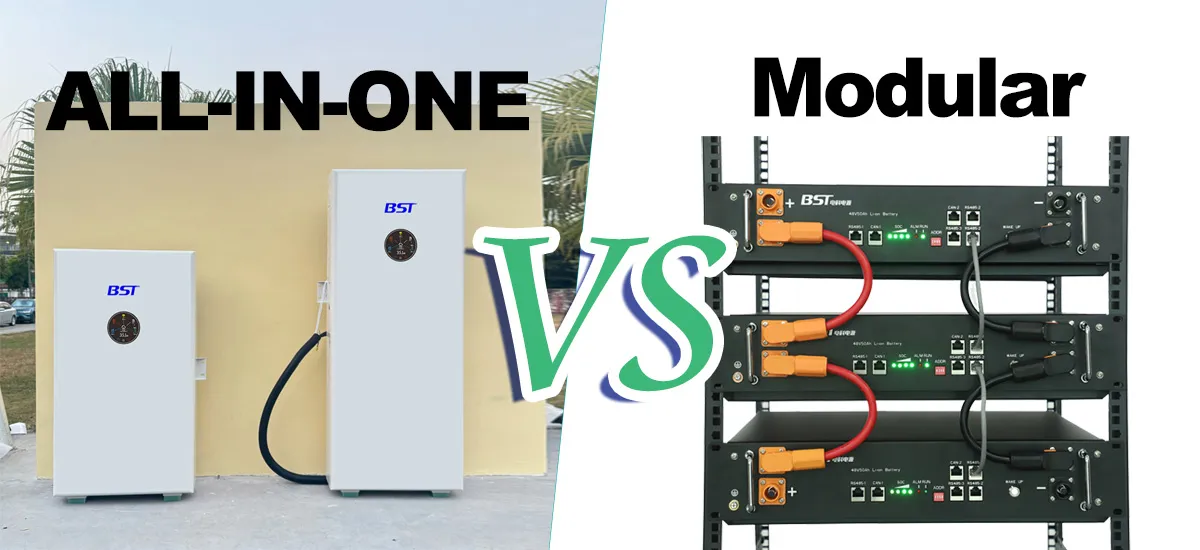 Modular VS ALL-IN-ONE
Both sound great, but which one is right for you? Which gives you more value for money? Which works better in the long run?
In this article, we’ll compare modular and all-in-one systems side by side — from installation, scalability, and maintenance to pricing — so you can see the differences at a glance and pick the one that truly fits your needs.
After all, choosing the right one doesn’t just save you time and money — it also speeds up your return on solar investment.
1. Introduction: Why Your Choice Matters
The demand for home energy storage systems is growing rapidly. Rising electricity prices, increasing power outages, and the push for clean energy have made home battery systems an essential part of modern living.
Whether you want to store excess solar energy, reduce your reliance on the grid, or have a reliable backup during blackouts, the type of system you choose will greatly affect your investment’s value and performance.
Today, two main options dominate the market:
- Modular Home Energy Storage Systems
- All-in-One Home Energy Storage Systems
Both have unique benefits and trade-offs. The right choice depends on your energy needs, budget, installation space, and long-term goals. This guide will explain each system in detail, compare their strengths and weaknesses, and offer professional advice tailored to different customer needs.
2. What is Modular Home Energy Storage?
A modular home energy storage system is built from multiple battery modules that can be added, replaced, or upgraded over time.
Think of it like LEGO blocks—you start with a base system and expand as your energy needs grow.
Key Features
- Expandable design: Add more capacity when needed
- Independent module replacement: No need to replace the entire system if one module fails
- Adaptable performance: Suitable for both residential and commercial applications
Advantages
- Scalability – Ideal for future expansion
- Cost efficiency over time – Spread out investment by adding modules later
- Reduced downtime – Faulty modules can be replaced without affecting the whole system
Potential Drawbacks
- More complex installation – Requires professional wiring and configuration
- Slightly higher initial setup cost compared to entry-level all-in-one systems
3. What is All-in-One Home Energy Storage?
An all-in-one home energy storage system integrates the battery pack, inverter, and control electronics in a single unit.
It arrives from the factory fully assembled, pre-configured, and ready for installation.
Key Features
- Plug-and-play installation – Minimal setup time
- Compact design – Suitable for smaller spaces
- Optimized compatibility – All components are matched for peak performance
Advantages
- Quick installation – Often ready in a single day
- Space-saving – Aesthetic design fits in garages, utility rooms, or even indoors
- Lower entry cost – Great for homeowners with smaller budgets
Potential Drawbacks
- Limited scalability – Increasing capacity usually requires replacing the entire system
- Component dependency – If one part fails, the entire unit may need servicing
4. Modular vs All-in-One: Key Comparison Table
| Feature | Modular Home Energy Storage | All-in-One Home Energy Storage |
|---|---|---|
| Scalability | High – Add modules anytime | Low – Fixed capacity |
| Initial Cost | Slightly higher | Lower |
| Installation Complexity | Higher – Requires professional configuration | Low – Plug-and-play |
| Maintenance | Replace faulty modules individually | Fault may require unit replacement |
| Space Requirements | Requires dedicated installation space | Compact, minimal footprint |
| System Compatibility | Requires matching components | Fully pre-configured |
| Long-Term ROI | Higher due to upgrade potential | Stable but limited growth |
5. Expert Recommendations for Different Customers
5.1 Small Homes or Apartments
- Profile: Low energy consumption, limited space, cost-conscious
- Recommendation: All-in-One
- Reason: Affordable, compact, and easy to install without major electrical modifications.
5.2 Large Houses or High Energy Users
- Profile: Multiple EV chargers, pool heating, large appliances
- Recommendation: Modular
- Reason: Allows future expansion to meet growing electricity needs.
5.3 Staged Investment Customers
- Profile: Want to start small but plan to expand later
- Recommendation: Modular
- Reason: Flexible upgrade path spreads investment over time.
5.4 Remote or Off-Grid Homes
- Profile: Prioritize reliability, limited installer availability
- Recommendation: All-in-One
- Reason: Fewer components to install and maintain, higher system stability.
5.5 Quick Installation Needs
- Profile: Require immediate backup solution
- Recommendation: All-in-One
- Reason: Can be operational within hours of delivery.
6. Real-World Examples
Case 1 – Modular System in Germany
A homeowner started with a 10kWh modular battery to store solar energy. Three years later, they purchased an electric vehicle and expanded capacity to 15kWh simply by adding new modules. The upgrade took one day and did not require changing the inverter.
Case 2 – All-in-One System in Australia
An apartment owner installed a 5kWh all-in-one system to provide backup for essential appliances. Installation was completed in half a day, and the system has operated without issue for over two years.
7. BST Power: Providing Both Modular and All-in-One Solutions
With 23 years of experience in home energy storage manufacturing, BST Power delivers high-quality, customizable solutions for global customers:
- Modular systems: 5kWh–20kWh, easily expandable
- All-in-One systems: 5kWh–15kWh, ready-to-use design
- Global certifications: CE, UL, IEC, and more
- Technical support: 24/7 after-sales assistance
- Tailored solutions: Residential, commercial, and off-grid applications

8. Conclusion: Making the Right Choice
Your choice between modular and all-in-one home energy storage depends on your:
- Budget
- Space availability
- Energy consumption patterns
- Future expansion plans
Choose Modular if you want maximum flexibility, scalability, and long-term ROI.
Choose All-in-One if you prefer simplicity, compact design, and quick installation.
Regardless of the system type, working with a reliable manufacturer is essential for safety, performance, and after-sales support.
9. Frequently Asked Questions (FAQ)
1. Can I expand a modular system later?
Yes. Simply add more compatible modules and update the system configuration.
2. Can I replace the battery in an all-in-one unit?
Usually, the entire unit is serviced or replaced by the manufacturer.
3. Which is better for off-grid living?
All-in-One is simpler to install, while Modular offers more flexibility for long-term energy independence.
4. How long does installation take?
Modular: Typically 1–2 days. All-in-One: Often same-day completion.
5. Do these systems have different lifespans?
Lifespan depends on battery chemistry and usage patterns, not the system type.
When it comes to choosing a home energy storage system, have you ever wondered: Should I go for modular or all-in-one?
A modular system is like “building blocks” — you can expand it anytime to match your energy needs, offering flexibility and freedom. An all-in-one system, on the other hand, is the “all-rounder” — fully integrated, ready to use, and hassle-free.
Modular VS ALL-IN-ONEBoth sound great, but which one is right for you? Which gives you more value for money? Which works better in the long run?
In this article, we’ll compare modular and all-in-one systems side by side — from installation, scalability, and maintenance to pricing — so you can see the differences at a glance and pick the one that truly fits your needs.
After all, choosing the right one doesn’t just save you time and money — it also speeds up your return on solar investment.
1. Introduction: Why Your Choice Matters
The demand for home energy storage systems is growing rapidly. Rising electricity prices, increasing power outages, and the push for clean energy have made home battery systems an essential part of modern living.
Whether you want to store excess solar energy, reduce your reliance on the grid, or have a reliable backup during blackouts, the type of system you choose will greatly affect your investment’s value and performance.
Today, two main options dominate the market:
- Modular Home Energy Storage Systems
- All-in-One Home Energy Storage Systems
Both have unique benefits and trade-offs. The right choice depends on your energy needs, budget, installation space, and long-term goals. This guide will explain each system in detail, compare their strengths and weaknesses, and offer professional advice tailored to different customer needs.
2. What is Modular Home Energy Storage?
A modular home energy storage system is built from multiple battery modules that can be added, replaced, or upgraded over time.
Think of it like LEGO blocks—you start with a base system and expand as your energy needs grow.
Key Features
- Expandable design: Add more capacity when needed
- Independent module replacement: No need to replace the entire system if one module fails
- Adaptable performance: Suitable for both residential and commercial applications
Advantages
- Scalability – Ideal for future expansion
- Cost efficiency over time – Spread out investment by adding modules later
- Reduced downtime – Faulty modules can be replaced without affecting the whole system
Potential Drawbacks
- More complex installation – Requires professional wiring and configuration
- Slightly higher initial setup cost compared to entry-level all-in-one systems
3. What is All-in-One Home Energy Storage?
An all-in-one home energy storage system integrates the battery pack, inverter, and control electronics in a single unit.
It arrives from the factory fully assembled, pre-configured, and ready for installation.
Key Features
- Plug-and-play installation – Minimal setup time
- Compact design – Suitable for smaller spaces
- Optimized compatibility – All components are matched for peak performance
Advantages
- Quick installation – Often ready in a single day
- Space-saving – Aesthetic design fits in garages, utility rooms, or even indoors
- Lower entry cost – Great for homeowners with smaller budgets
Potential Drawbacks
- Limited scalability – Increasing capacity usually requires replacing the entire system
- Component dependency – If one part fails, the entire unit may need servicing
4. Modular vs All-in-One: Key Comparison Table
| Feature | Modular Home Energy Storage | All-in-One Home Energy Storage |
|---|---|---|
| Scalability | High – Add modules anytime | Low – Fixed capacity |
| Initial Cost | Slightly higher | Lower |
| Installation Complexity | Higher – Requires professional configuration | Low – Plug-and-play |
| Maintenance | Replace faulty modules individually | Fault may require unit replacement |
| Space Requirements | Requires dedicated installation space | Compact, minimal footprint |
| System Compatibility | Requires matching components | Fully pre-configured |
| Long-Term ROI | Higher due to upgrade potential | Stable but limited growth |
5. Expert Recommendations for Different Customers
5.1 Small Homes or Apartments
- Profile: Low energy consumption, limited space, cost-conscious
- Recommendation: All-in-One
- Reason: Affordable, compact, and easy to install without major electrical modifications.
5.2 Large Houses or High Energy Users
- Profile: Multiple EV chargers, pool heating, large appliances
- Recommendation: Modular
- Reason: Allows future expansion to meet growing electricity needs.
5.3 Staged Investment Customers
- Profile: Want to start small but plan to expand later
- Recommendation: Modular
- Reason: Flexible upgrade path spreads investment over time.
5.4 Remote or Off-Grid Homes
- Profile: Prioritize reliability, limited installer availability
- Recommendation: All-in-One
- Reason: Fewer components to install and maintain, higher system stability.
5.5 Quick Installation Needs
- Profile: Require immediate backup solution
- Recommendation: All-in-One
- Reason: Can be operational within hours of delivery.
6. Real-World Examples
Case 1 – Modular System in Germany
A homeowner started with a 10kWh modular battery to store solar energy. Three years later, they purchased an electric vehicle and expanded capacity to 15kWh simply by adding new modules. The upgrade took one day and did not require changing the inverter.
Case 2 – All-in-One System in Australia
An apartment owner installed a 5kWh all-in-one system to provide backup for essential appliances. Installation was completed in half a day, and the system has operated without issue for over two years.
7. BST Power: Providing Both Modular and All-in-One Solutions
With 23 years of experience in home energy storage manufacturing, BST Power delivers high-quality, customizable solutions for global customers:
- Modular systems: 5kWh–20kWh, easily expandable
- All-in-One systems: 5kWh–15kWh, ready-to-use design
- Global certifications: CE, UL, IEC, and more
- Technical support: 24/7 after-sales assistance
- Tailored solutions: Residential, commercial, and off-grid applications
8. Conclusion: Making the Right Choice
Your choice between modular and all-in-one home energy storage depends on your:
- Budget
- Space availability
- Energy consumption patterns
- Future expansion plans
Choose Modular if you want maximum flexibility, scalability, and long-term ROI.
Choose All-in-One if you prefer simplicity, compact design, and quick installation.
Regardless of the system type, working with a reliable manufacturer is essential for safety, performance, and after-sales support.
9. Frequently Asked Questions (FAQ)
1. Can I expand a modular system later?
Yes. Simply add more compatible modules and update the system configuration.
2. Can I replace the battery in an all-in-one unit?
Usually, the entire unit is serviced or replaced by the manufacturer.
3. Which is better for off-grid living?
All-in-One is simpler to install, while Modular offers more flexibility for long-term energy independence.
4. How long does installation take?
Modular: Typically 1–2 days. All-in-One: Often same-day completion.
5. Do these systems have different lifespans?
Lifespan depends on battery chemistry and usage patterns, not the system type.

Copyright © 2026 BST POWER. All rights reserved.